
Columbus Criminal History Checks
Match the search to the custodian. Columbus Police creates offense and arrest reports. The City Secretary receives written public-information requests for city records. Columbus Municipal Court keeps city ordinance, traffic, and other fine-only state-law cases. A custodial arrest may lead to a Colorado County jail record and then a county misdemeanor or felony case. DPS receives reportable events for the statewide criminal-history system after the responsible agencies send them.
Use this order when the event began in Columbus:
- Ask Columbus Police or the City Secretary for the police incident, offense, crash, or arrest report.
- Describe the event with a date, location, involved name, and report or citation number when known.
- Search Columbus Municipal Court when the matter is a city ordinance, traffic, or fine-only charge.
- Call the Colorado County Sheriff for a possible jail booking, then use the proper county clerk if a higher-level charge was filed.
- Use the Texas DPS name search for public statewide conviction and deferred-adjudication history, or fingerprints when reviewing your own complete Texas record.
Each source answers a different question. A Columbus incident report records police work. A citation file records court handling. A jail entry documents custody, while DPS provides a narrower statewide public history. No single search replaces the rest.
Four Columbus Record Request Channels
Columbus sends public requests to the City Secretary. A requester can deliver a written request by mail, fax, in person, or through the email link on the official public-information page. The request should describe the sought record well enough for staff to identify it. Inspection is usually free. If production cannot occur within ten working days, the city gives a reasonable availability date. Cost estimates begin when expected charges exceed $40, and a deposit may be required at statutory thresholds.
| Channel | Destination | Useful detail |
|---|---|---|
| In person | City Secretary, 605 Spring Street | Bring a clear written description |
| P.O. Box 87, Columbus, TX 78934 | Keep a copy of the signed request | |
| Fax | 979-732-8213 | Retain the transmission record |
| Email link | City public-information page | Use the city's posted contact route |
The public-information page was one of two successful Columbus image captures in the manifest. Review the city request instructions before looking at the captured page.
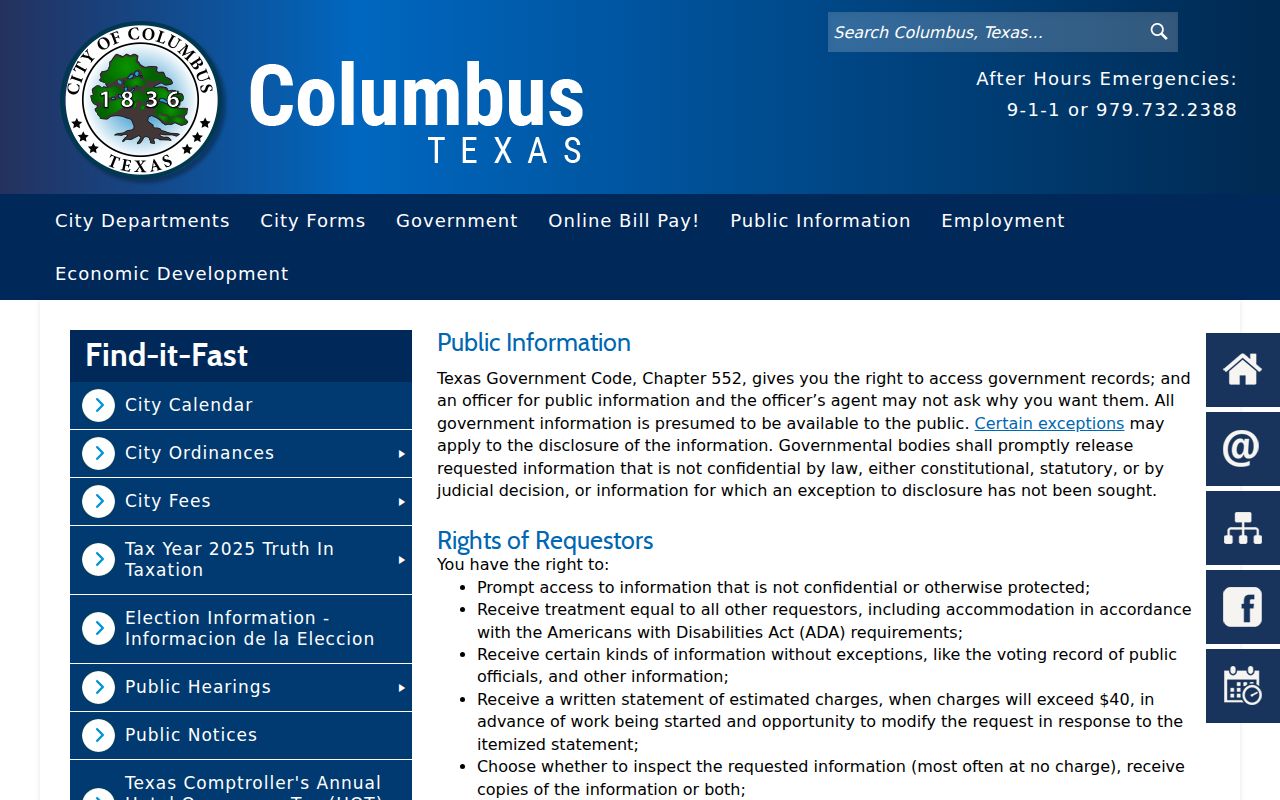
The city screen reinforces the practical point: send the request to the City Secretary and state the exact Columbus record needed, rather than sending a broad request to an unrelated county office.
Records at the Columbus Police Department
The Columbus Police Department operates from the second floor of City Hall at 605 Spring Street. Mail goes to P.O. Box 87, Columbus, TX 78934. The nonemergency number is 979-732-3351, while emergencies go to 911. The official department description lists 11 patrol cars and provides links to TxDOT's crash system and P3 Tips. It does not advertise an online arrest blotter, a local report database, or a police mobile app.
That absence sets the fallback chain. Ask police or the City Secretary for a Columbus-created report. Use TxDOT crash-report access when the desired item is a qualifying crash report. Contact the county jail only for custody facts after a custodial arrest. A report request should identify the event, date or date range, location, involved person, and known report number. Staff may redact protected information or withhold material covered by law.
Note: A later county booking does not transfer custody of the original Columbus police report from the city to the sheriff.
Columbus Citation Record Search Routes
The Columbus Municipal Online Services search accepts six routes. No login is required to search, though the service needs JavaScript. Each route uses a different group of identifiers. A citation number is direct when the ticket is available. A name search needs first name, last name, and date of birth. Driver's-license, vehicle, Social Security number, and business-name routes are also present.
| Search method | Fields | Required format |
|---|---|---|
| Citation Number | Citation number and DOB | Both; DOB MM/DD/YYYY |
| Driver's License | DL number, state, and DOB | State list includes all states and DC |
| Social Security Number | SSN and DOB | SSN 111-22-3333 plus DOB |
| Vehicle Information | Plate and state | Both fields |
| Name | First, last, and DOB | All listed fields |
| Business Name | Business name | Text |
A no-result screen does not rule out every Columbus record. The citation may be too new, a field may not match, or the matter may belong in a county court. Call the court clerk rather than trying repeated guesses with sensitive identifiers.
Booking and Arrest Records in Columbus
Columbus publishes no city jail and no local arrest log. For a custodial police arrest, the practical next step is to call the Colorado County Sheriff's Office at 979-732-2388 and ask for the Jail Division. This is an evidence-based routing inference, not an official city promise that every arrested person enters county custody. A citation release, transfer, medical hold, or another agency's custody can change the path.
A Columbus police report and a county jail booking should not be blended. The police record can show the event, responding officer, initial allegation, and narrative subject to release rules. A booking can show admission, arrest-stage charges, bond, and custody or release status. Neither proves guilt. If prosecutors file a charge, the court record becomes the best source for the filed allegation and result. County-wide arrest channels are covered in the Colorado County arrest search.
The Columbus Municipal Court File
Columbus Municipal Court is at 605 Spring Street and receives mail at P.O. Box 705, Columbus, TX 78934. The clerk can be reached at 979-732-3981 or court@columbustexas.net. Posted hours are Monday through Friday, 8 a.m. to 4:30 p.m. The court handles city ordinance, traffic, and other fine-only matters. It is not the keeper of felony files or the constitutional County Court's Class A and B misdemeanors.
| Court | Columbus Municipal Court at City Hall |
|---|---|
| Case scope | City ordinance, traffic, and fine-only state-law matters |
| Search channel | Municipal Online Services, clerk email, telephone, or counter |
| Search identifiers | Citation, driver's license, SSN, vehicle, name, or business data |
| Reply options | Pay, request DSC, request deferred disposition, or contest before judge or jury |
| County boundary | Higher misdemeanor and felony files belong to Colorado County clerks |
The Municipal Court page is the other successful Columbus image assigned in the manifest. Consult the official Columbus court source before viewing the captured record page.
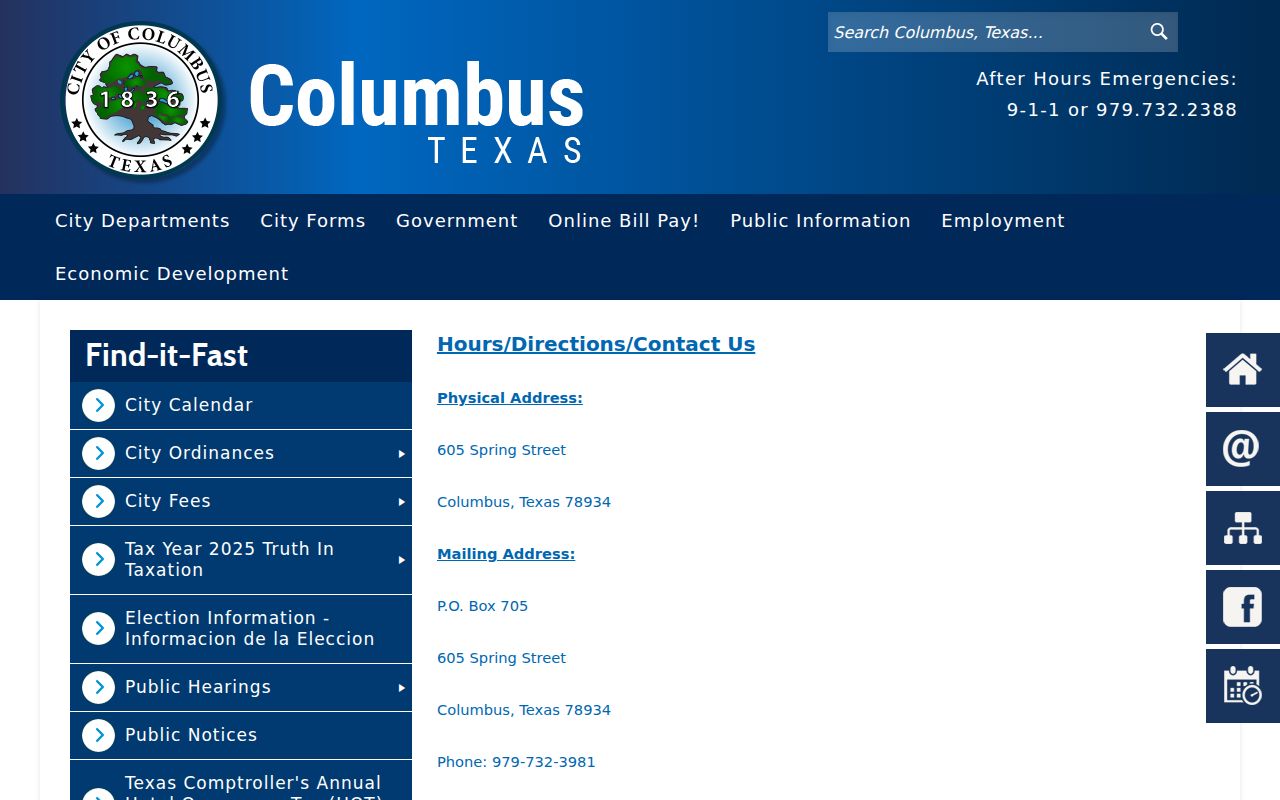
The city court source connects search, contact, and form channels in one place, but the underlying Columbus court file remains the authority for its docket and disposition.
Columbus Court Online Payment Trap
The court warns people not to pay online when they want a driving safety course or deferred disposition. Those requests stay offline and carry supporting requirements. The driving safety course checklist includes no commercial driver's license, no similar course in the prior 12 months, no simultaneous request, and specified speed and work-zone limits. The packet also calls for notarization, proof documents, a Type 3A DPS driving record, and payment by cashier's check or money order.
The researched form lists $144 for the course request and $169 for a school-zone violation. Deferred disposition carries related identity, insurance, and Type 3A record requirements, plus the full fine. A missed appearance can add a $50 warrant fee. These figures come from the published reply form and should be confirmed with the clerk before payment. A warrant can remain active until the amount is paid in full, so a person who sees one should contact the court promptly rather than assuming an online search cleared it.
How Columbus Records Reach the County
A city case does not always remain in city systems. Columbus Police creates the first incident or arrest event. Fine-only and ordinance cases can stay in Municipal Court. A higher offense may go to a county prosecutor and the proper Colorado County clerk. Booking data follows the jail custodian, and reportable arrest and disposition events ultimately move into the Texas DPS Computerized Criminal History system under state reporting rules.
Record flow: Columbus Police › Columbus Municipal Court or Colorado County Courts › Texas Department of Public Safety.
Recent facts tend to appear closest to the source. Call Columbus Police for the report, the sheriff for current county custody, and Municipal Court for its citation docket. Use the District Clerk for felony case files and the County Clerk for Class A and B misdemeanor cases. DPS is the later statewide layer, not a substitute for the city report or complete court file. The broader Colorado County criminal history overview explains those county and state routes without changing who keeps the Columbus original.
Columbus Police Records in Context
An official September 2020 agenda packet reported 221 calls, 18 incidents, 12 arrests, 38 citations, 76 warnings, eight crashes, and two mental transports. Those numbers illustrate the mix of records produced during one reported month. They are not a current crime rate and should not be used to describe present conditions. Calls can close without an arrest, citations can avoid a custodial booking, and warnings may never produce a court case.
That distinction also helps with search choices. A caller who recalls police activity may need an incident report even when no name appears in a jail system. A citation recipient should search Municipal Court, not a booking log. Columbus sits along Interstate 10 and the Colorado River, and traffic, crash, and city-service records can arise from that setting. The city's rail past remains visible in MidTown Park, but historic context does not change which modern office holds a police or court record.
Columbus Record Access Rules
The Texas Public Information Act applies to records held by the City of Columbus unless another law makes the material confidential or permits withholding. The city does not have to create a new record to answer a request. Police material may be redacted for protected personal facts, victim information, juveniles, or an active investigation. Court judicial records follow court and clerk access rules; a city public-information request does not replace the court's record process.
Key statutes:
Texas Government Code Chapter 552 gives access to public information held by government bodies, subject to confidentiality and statutory exceptions.
Texas Government Code Chapter 411 limits criminal-history dissemination while authorizing public conviction and deferred-adjudication access through DPS.
Texas Code of Criminal Procedure Chapter 66 governs reporting of criminal-justice events into the statewide system.
Ask for a public redacted copy when that would meet the need. Keep the city's response, estimate, and any explanation of withheld material. If a Columbus citation or police record appears wrong, raise the issue with the office that created it. A search result from another system cannot amend the original city file.
Columbus Arrest Records After Transfer
Once a person leaves city custody, the record trail can split. The Colorado County Sheriff's Office and Detention Facility at 2215 Walnut Street holds sheriff booking and current-custody information. Its main number is 979-732-2388, with option or extension 2 for the Jail Division. The sheriff can confirm whether a Columbus arrest led to county intake, but the office should not be asked to produce a Columbus Police narrative it did not create.
After filing, the case level decides the clerk. The County Clerk handles constitutional County Court criminal cases, generally Class A and B misdemeanors. The District Clerk handles felony files for the district courts. Municipal citations remain with Columbus Municipal Court. This handoff explains why one name can generate a city report, jail booking, county court file, and DPS event with different charges or dates. Compare each record by agency, event date, and case or booking number before assuming they describe the same matter.