
Colorado County Criminal History Checks
Start by deciding what the record must answer. A Colorado County jail booking confirms intake and custody at one point in time. A clerk file shows the charge prosecutors filed, later hearings, and the result. The Texas DPS Criminal History Conviction Name Search reaches public conviction and deferred-adjudication data reported from across Texas. None is a full substitute for the others. For a review of your own Texas history tied to identity rather than a similar name, use fingerprints through DPS Fingerprint Applicant Services of Texas.
Gather a full legal name, date of birth, possible middle or maiden name, and any known case, report, SID, or booking number. Search city and Justice Court matters separately when the event began below the county level. Compare each hit with the right person before opening or ordering a file. A no-match may reflect spelling, reporting delay, a restricted record, or the wrong office. It does not prove that no record exists.
- Choose booking, court, warrant, or statewide history based on the question.
- Search the County Clerk portal for Class A and B misdemeanors, or use the District Clerk terminal for felonies.
- Match names with dates of birth, middle names, case numbers, and other known facts.
- Compare an online hit with the source file held by the arresting agency or clerk.
- Order a certified copy or a fingerprint personal review when the purpose requires an official record.
Colorado County's Three-Part Record
A criminal event can create three records with different jobs. The arresting officer and jail document the allegation, identity check, bond, and custody. A Colorado County clerk then documents what was actually filed and how the court ruled. DPS receives reportable events for the Computerized Criminal History system. The first arrest charge can be reduced, replaced, rejected, dismissed, or no-billed, so the three views may not match word for word.
The practical flow is: Arrest and Booking → Prosecutor Review → Court Filing and Disposition → DPS CCH Update. Reporting can be late or incomplete. When a public DPS result lacks an outcome, compare it with the originating clerk's judgment and ask that agency and DPS about correction. For deeper case detail, the Colorado County court case lookup explains the separate misdemeanor and felony routes.
Colorado County's official county directory shows why office selection matters. The image below captures that government starting point.
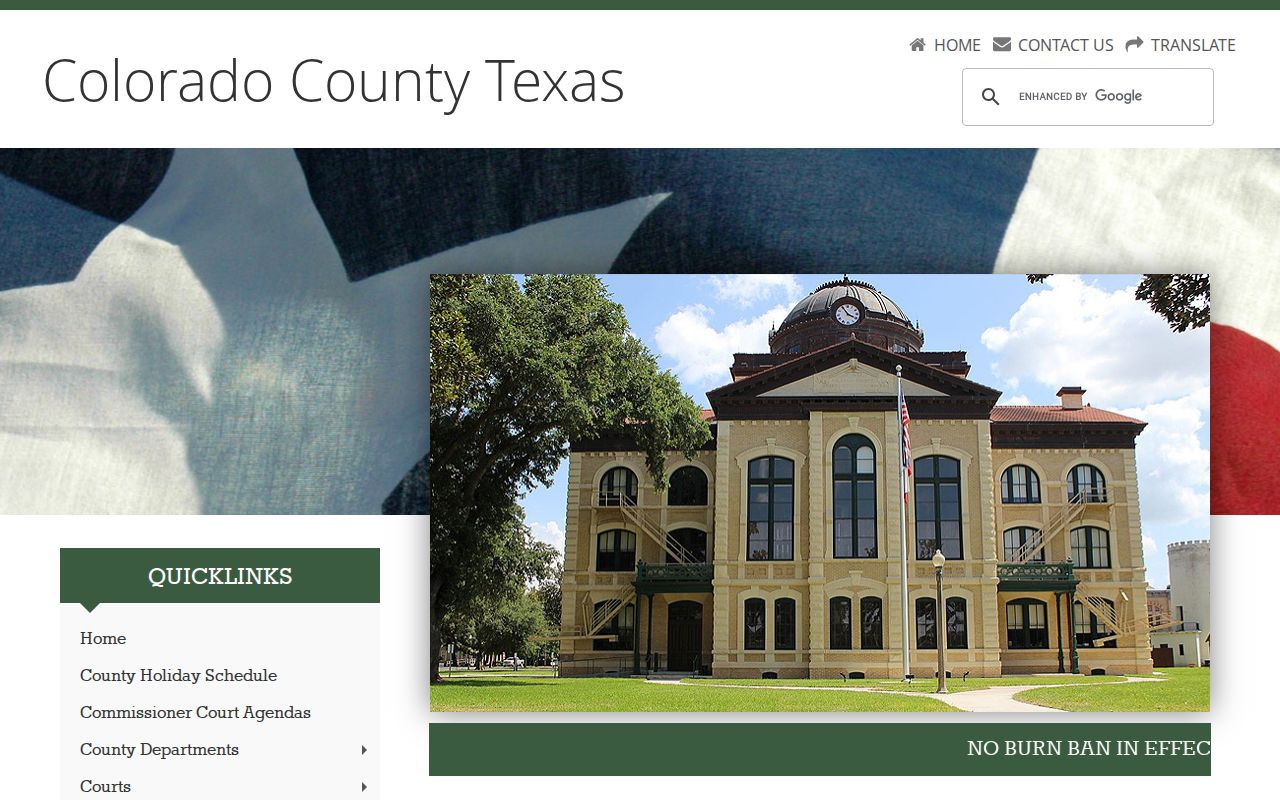
Use the directory to confirm a department before a visit, then use the clerk, sheriff, or city channel that created the sought record.
Official Background Checks in Texas
The Texas Department of Public Safety Crime Records Division operates CCH. Its public name search returns information Texas law makes public, chiefly reported convictions and deferred adjudications. An account and prepaid credits are required. Each submitted search costs one $1 credit, including a no-match. Card purchases add 2.25% per credit and a $0.25 transaction charge. DPS also accepts the CR-42 mailed public search for $10 per subject.
A fingerprint personal review is the stronger route for your own record because prints establish identity. Follow DPS form CR-63 and schedule FAST capture through IdentoGO by IDEMIA. DPS lists a $15 record-check fee plus a $10 FAST electronic fingerprint fee; service-code transactions can differ. An FBI Identity History Summary is a separate subject-only national product with an $18 federal fee.
| Official product | Fee found | Main limit |
|---|---|---|
| DPS online name search | $1 credit | Name-based public conviction and deferred data |
| DPS CR-42 by mail | $10 | Public search, not fingerprint verified |
| DPS personal record review | $15 plus capture | For the subject, fingerprints required |
| FBI Identity History Summary | $18 | National subject-only review |
| District Clerk copies | $1 per page | Local felony court file |
Colorado County's One-Dollar DPS Search
The low price can make the DPS product look broader than it is. It is not a complete rap sheet and is not fingerprint verified. Enter full legal first and last names; a middle or maiden name and full date of birth can narrow the match. DPS tests full, partial, and Soundex name combinations. Its Preview function helps compare descriptors before selecting a record, but only fingerprints establish a positive biometric match.
The DPS public search interface shown below is the official statewide name-check channel for Colorado County records that have been reported and are public by law.
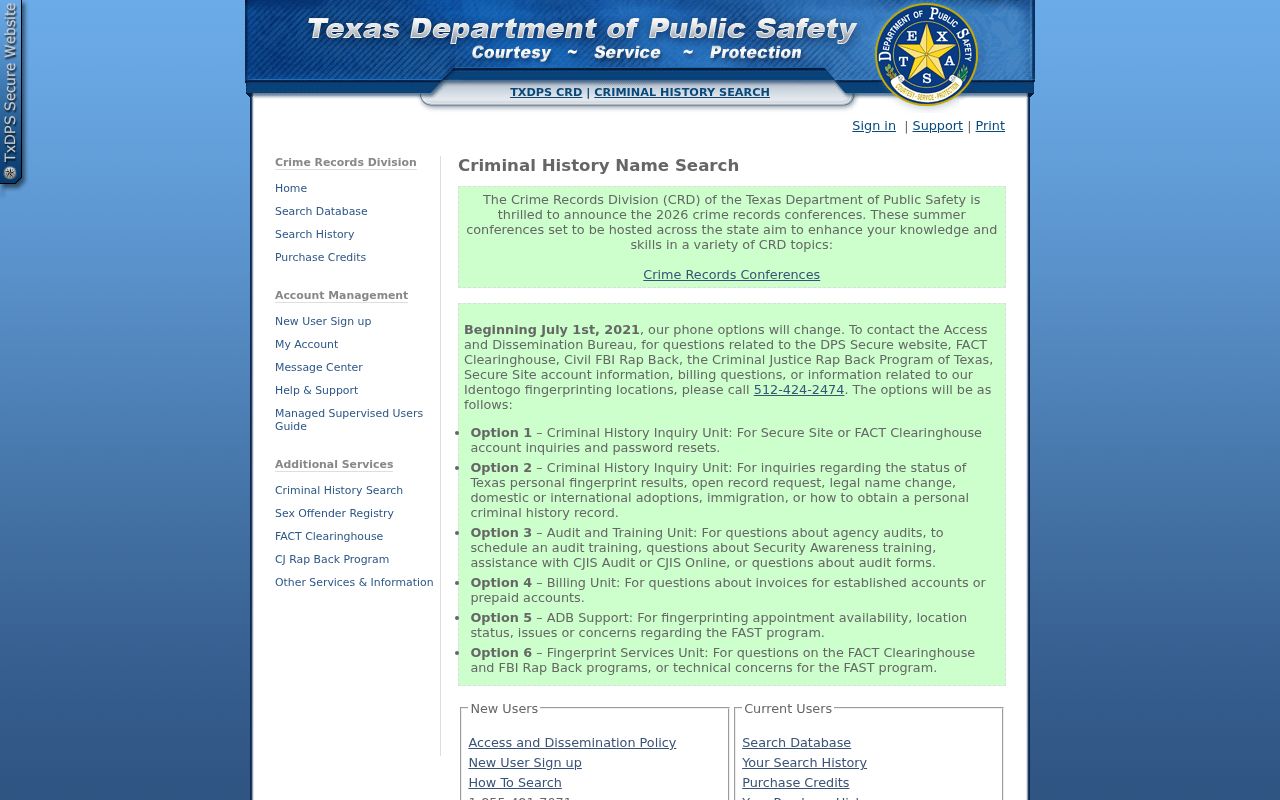
A submitted search consumes a credit even with no result. Search history remains available for three years, while an offline file may be queued for later technician processing.
| Field | Required | Use |
|---|---|---|
| Last name | Yes | Full legal name |
| First name | Yes | Full legal name |
| Middle or maiden name | No | Improves matching |
| Date of birth | No | Full or partial date narrows results |
| Preview | Result action | Compare the potential match before selection |
Kinds of Criminal Records
Colorado County criminal records are organized by event and custodian. A city police department or sheriff creates an offense and arrest report. The county jail adds booking data when it accepts a person. Prosecutors file a complaint, information, or indictment, and the proper clerk preserves the case docket. DPS aggregates eligible statewide events. The Texas Department of Criminal Justice keeps prison and parole information, while local police or the sheriff registers qualifying addresses for the Texas Public Sex Offender Registry.
That division explains why one query is rarely universal. A city report does not move into the sheriff's records cabinet merely because a person later reaches the county jail. A booking does not acquire the court's final outcome. A court judgment can show community supervision, but the Colorado County CSCD does not publish a probation roster. Search each source for the fact it was built to preserve.
- Arrest and booking records: the arresting agency and county jail describe intake-stage facts.
- Court case files: municipal, Justice, County, and District clerks preserve filings and outcomes.
- CCH entries: DPS compiles public reportable Texas conviction and deferred cycles.
- Warrants: the issuing court and law enforcement may hold distinct warrant data.
- Supervision and registry records: county CSCD, TDCJ, DPS, and local registrars divide responsibility.
Colorado County Police Reports Stay Local
Police and incident reports remain with the agency that wrote them. Request a Columbus, Eagle Lake, or Weimar report from that city, even if the person later entered the Colorado County jail. Sheriff reports follow the county's written Public Information Act route.
Identify the date, place, involved roles, report number, requested portions, and delivery method. Use TxDOT CRIS for an official crash report. Active cases and protected identities may be withheld or redacted.
No Colorado County Jail Roster
No official Colorado County jail roster, booking blotter, or sheriff records app was found in the official-source review. The direct custody check is the Jail Division at 979-732-2388, option 2, or the lobby at 2215 Walnut Street in Columbus. A person released soon after booking may no longer appear in a current phone check. A precise written request can seek booking or arrest material that the sheriff holds.
VINELink supplies custody notifications, but it is not a full inmate roster. CodeRED sends urgent community alerts and is not a booking tool. Once a sentenced person moves to state prison, use the TDCJ Online Inmate Search with a name, SID, or TDCJ number. The county arrest page gives the full Colorado County arrest search fallback, including the separate route to a city police report.
Note: Current custody, an old booking, and state prison status are three different questions, each answered by a different Colorado County or Texas source.
Colorado County Criminal Records: What They Contain
A Colorado County record should be read in context. DPS CCH ties identity details to arrest cycles and reportable outcomes. A court file is richer on pleadings, hearings, judgment, sentence, bond, and money due. A booking record focuses on intake, arresting agency, initial charge, bond, and release. Protected victim and juvenile details, medical information, driver's-license numbers, and other sensitive identifiers may be removed from a public copy.
| Name and identifiers | Legal name, aliases, birth data, sex, race, SID, and sometimes FBI number. |
|---|---|
| Arrest and booking data | Agency, tracking or booking number, date, intake charge, bond, and custody status. |
| Charges and statutes | Filed offense, Texas citation, degree, and charging instrument. |
| Disposition | Dismissal, acquittal, conviction, deferred adjudication, or other current result. |
| Sentence | Jail or prison term, fine, restitution, and court-ordered supervision. |
| Custody or supervision | County custody, TDCJ placement, community supervision, or parole information where public. |
Colorado County Criminal Charge Classes
Felonies, including state jail through capital grades, belong in Colorado County District Court. Class A and B misdemeanors go to the constitutional County Court. Fine-only Class C cases may remain with a Justice or municipal court.
The arrest label can change after prosecutor review, enhancement, reduction, or plea. Read the filed grade and judgment, not just intake data. Texas Penal Code Chapter 12 supplies the punishment ranges, but grade alone does not decide record-relief eligibility.
Two Colorado County Room 103s
Colorado County has two clerk counters labeled Room 103. The District Clerk is in the historic courthouse at 400 Spring Street and keeps felony files for the 25th and 2nd 25th Judicial District Courts. The County Clerk is in the Courthouse Annex at 318 Spring Street and keeps constitutional County Court criminal cases, usually Class A and B misdemeanors. A records visitor who follows only the room number can reach the wrong building.
Both counters publish weekday hours of 8 a.m. to noon and 1 to 5 p.m. The District Clerk provides public search terminals because no local felony web search is advertised, and copies cost $1 per page. The County Clerk links Tyler Odyssey for misdemeanor case access. Call before travel for security or accessibility questions because parking, devices, and building-specific restrictions were not published in the reviewed county material.
District Clerk
400 Spring Street, Room 103
Columbus, TX 78934
979-732-2536
County Clerk
318 Spring Street, Room 103
Columbus, TX 78934
979-732-2155
Sheriff Records
2215 Walnut Street
Columbus, TX 78934
979-732-2388
Texas Public Access Laws
The Texas Public Information Act, Government Code Chapter 552, starts with a presumption that government information is available unless law makes it confidential or an exception applies. It does not turn every criminal history field into a public record. Government Code Chapter 411 controls DPS dissemination, and Section 411.135 authorizes the public conviction and deferred-adjudication product. Active investigations, juvenile matters, protected victims, and personal identifiers may be withheld or redacted.
Key Statutes:
Government Code Chapter 552 gives the public a right to inspect government information unless an exception or confidentiality rule applies.
Government Code Sections 411.083 and 411.135 limit full CCH access while authorizing the DPS public conviction and deferred search.
Code of Criminal Procedure Chapter 55A governs expunction of qualifying arrest and court records.
Code of Criminal Procedure Chapter 62 controls sex offender registration and public registry fields.
Colorado County Warrant Search Paths
Colorado County publishes no separate sheriff-branded warrant list. Tyler UCMS Smart Search includes an Include: Warrants control and filters for warrant type, status, and issue date. It can expose public UCMS entries, but an unentered, sealed, or differently held warrant may not appear. Weimar Municipal Court separately links an official outstanding-warrant folder, while other bench matters may remain with the municipal, Justice, County, or District clerk that issued them.
Use a layered check: search UCMS, call the issuing clerk, call sheriff dispatch at 979-732-2388, and submit a precise written request if needed. To address your own warrant, verify the issuing court, number, charge, bond, appearance rule, and what action recalls it. A payment screen does not prove instant clearance. Never approach a wanted person or send money after an unsolicited call.
- Arrest warrant
- A judge's order based on probable cause for an arrest.
- Bench warrant or capias
- A court order often tied to failure to appear, comply, or satisfy a judgment.
- Search warrant
- Authority to search a described place or item, sometimes sealed during an investigation.
Restricted, Sealed & Expunged Records
Texas uses two different forms of relief. An expunction under Code of Criminal Procedure Chapter 55A orders qualifying records removed and destroyed. An order of nondisclosure under Government Code Chapter 411, Subchapter E-1 usually limits public disclosure without making the event nonexistent for every authorized agency. Eligibility turns on the precise arrest cycle, charge, outcome, waiting period, and prior history. A dismissal alone does not automatically erase the booking.
Juvenile, sealed, expunged, victim-related, and confidential CCH material may be absent or redacted from a public result. That absence is not proof that an event never happened. Review the source docket and seek legal advice for a fact-specific eligibility judgment. The Colorado County District Clerk accepts filings at the courthouse and publishes a local instruction that can reduce service cost when used correctly.
Colorado County's Expunction Email Rule
The District Clerk's local expunction instructions contain a useful service detail. A petitioner may provide an email address for each listed agency. When an agency email is supplied, the clerk says electronic service avoids a $25 certified-mail issuance fee for that agency. The petition must still identify all agencies that may hold the arrest record, and the local detail does not decide whether the case qualifies under Chapter 55A.
Colorado County charges are divided across sheriff, city police, prosecutors, clerks, DPS, and supervision agencies, so incomplete service can leave a custodian outside the requested order. Build the list from the arrest and court files, not memory. Nondisclosure follows a different statute and effect. It restricts eligible public disclosure; it is not the same as the destruction ordered by expunction.
Colorado County Supervision Splits
Community supervision and parole are not the same system. Colorado County CSCD administers probation imposed by local County and District courts. The judgment and docket show what the judge ordered, while CSCD holds supervision administration that is not exposed as a public probation roster. TDCJ's Parole Division supervises people released from state prison, and the Texas Board of Pardons and Paroles makes release and revocation decisions.
The TDCJ Parole Division page shown below explains the statewide supervision side that applies after a Colorado County prison sentence.
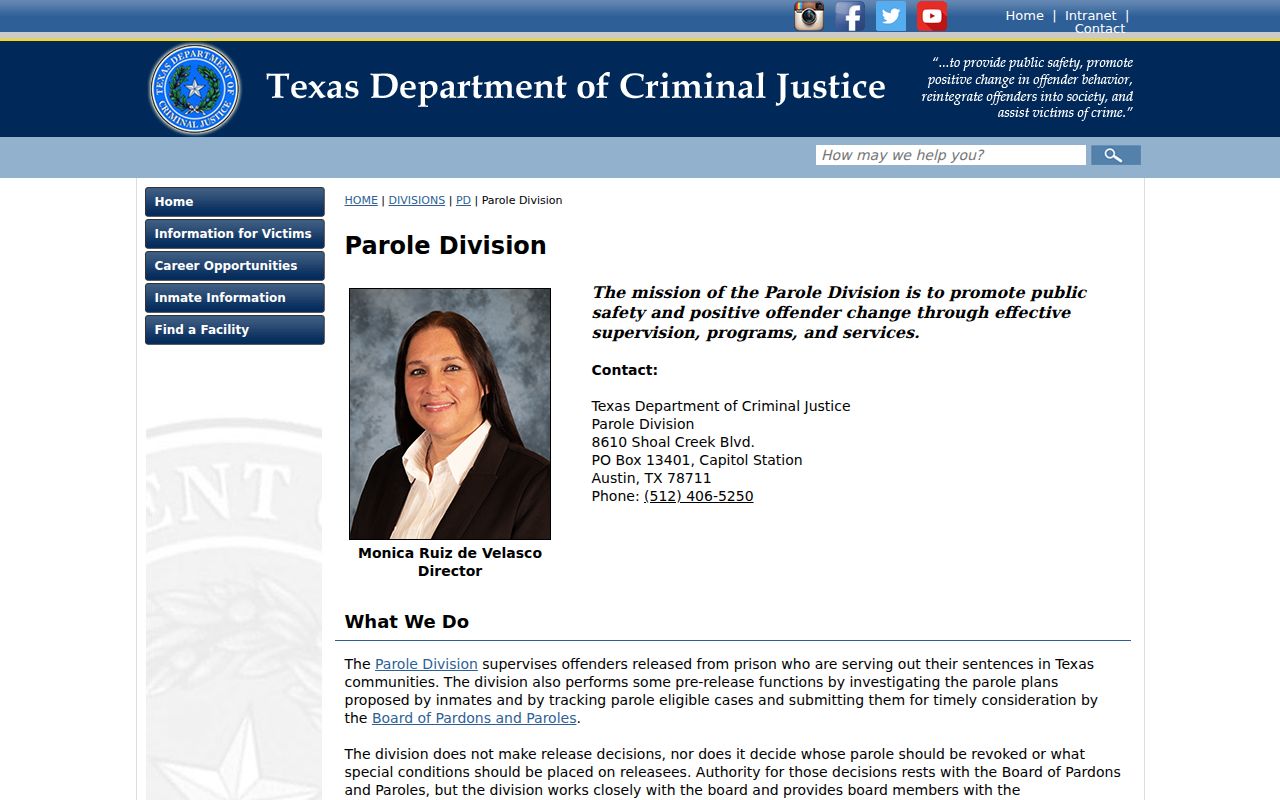
Colorado County maps to the Rosenberg District Parole Office. For status, start with the local judgment for probation, TDCJ IVSS for prison or parole, and the proper agency for any releasable detail.
The fingerprint route is also distinct. IdentoGO's FAST appointment site provides capture for a subject's Texas record review.
No permanent enrollment center inside Colorado County was confirmed, so the live location finder is the sound way to choose a current appointment site.
City-by-City Criminal Records in Colorado County
Columbus, Eagle Lake, and Weimar are Colorado County's three largest incorporated cities by the consistent 2020 Census ranking. Each police department writes its own reports, and each municipal court keeps fine-only state-law and ordinance matters. That local record may never appear in the same online path as a County Court misdemeanor or District Court felony. Start with the city that created the report or citation, then follow a custodial arrest to the Colorado County jail and a filed higher charge to the proper county clerk.
Columbus Record Check
3,699 · Police records, open requests, and Municipal Court searches at City Hall.
Eagle Lake Record Check
3,442 · Police records counter, sheriff dispatch, and Municipal Court access.
Weimar Record Check
2,076 · Police forms, public warrants, dockets, and Monday court sessions.