
Colorado County Sex Offender Checks
The Texas Public Sex Offender Registry is the main public channel for Colorado County. Texas DPS maintains the central system, while a city police department generally registers a person who lives inside that city. The Colorado County Sheriff serves that role outside a municipality. The registry is free, statewide, and built for public safety. It is more useful than an ordinary criminal-history name search when the goal is to confirm whether a person has an active Texas registration record.
Start with the narrowest reliable facts. A full name can work, but an area search is often better for learning about registered addresses near a home, school route, or family gathering place. A State Identification number, or SID, can separate similar names when that identifier is known. Searchers should compare the photo, physical description, aliases, date of birth, address, and offense facts rather than relying on a name alone. For a disputed Colorado County address or suspected failure to report, contact the authority that registers that address instead of drawing a conclusion from a screen.
Colorado County Registry Search Modes
Texas supports several routes into the same registry. Name mode follows a known person. Area mode works from a street, city, ZIP code, or county. SID mode is best when an official Texas identifier is available. Map or current-location tools help with place-based awareness, and the portal also identifies an institution-of-higher-education category. Exact radius choices were not reliably exposed during the research review, so no fixed distance should be assumed.
The official registry interface was captured for the Colorado County lookup assignment. See the Texas DPS registry search source before reviewing the form shown below.
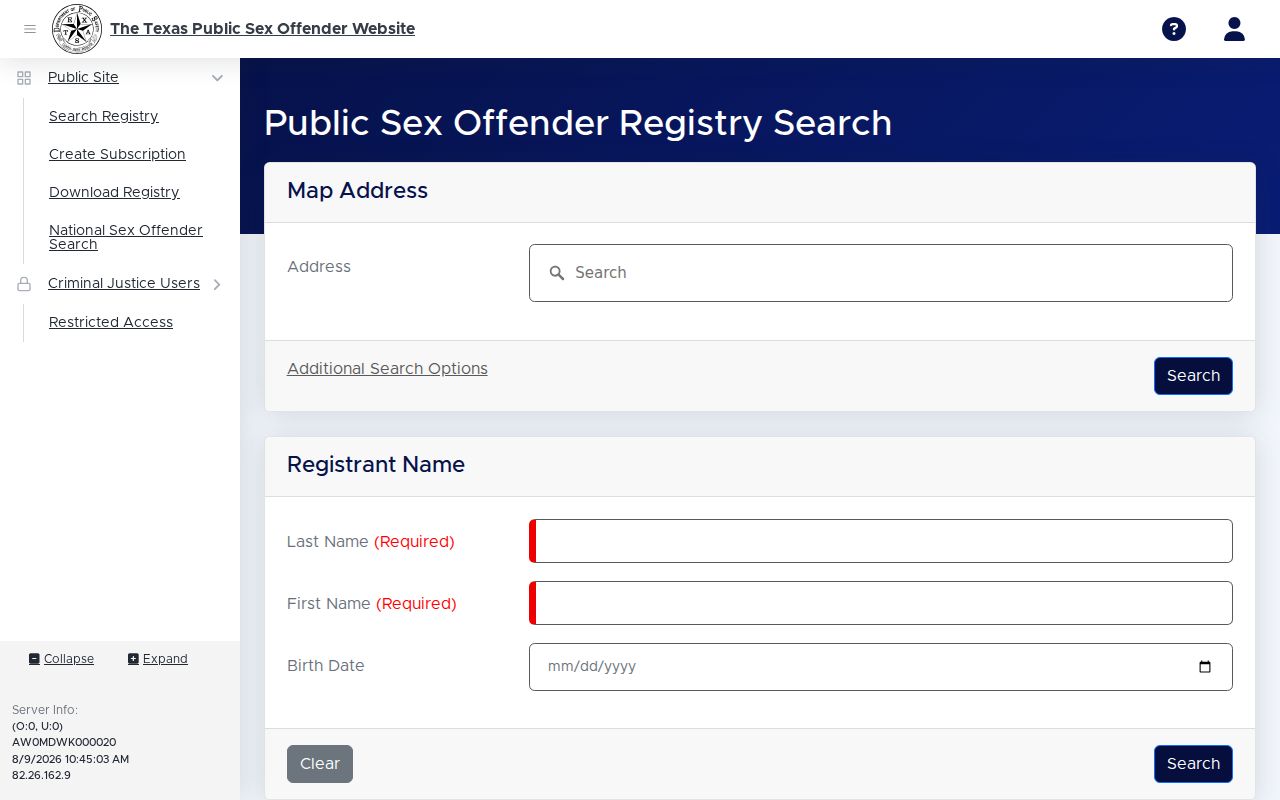
The search screen shows why the search mode matters: the reader chooses a person-based or place-based route before comparing any returned Colorado County registry profile.
Texas Public Sex Offender Registry Searches
DPS presents the public registry as a search tool with conditions on its use. Work from official identifiers and treat the first result list as a set of possible matches. A careful search has four parts:
- Open the official Texas registry and review the conditions governing access and use.
- Select name, address, city, ZIP, county, SID, map, current-location, or higher-education mode as the facts permit.
- Submit the search and compare the available descriptors, address, and aliases across possible results.
- Open the matching profile, note its status and verification facts, then contact the registering authority if a current local fact needs confirmation.
No field should be treated as a promise of a match. A person may use an alias, an address can change, and a place-based result can cross a city boundary. These are the documented public controls:
| Field or control | Type | Use | Notes |
|---|---|---|---|
| Name | Text | Person search | Aliases may appear in results |
| Address, City, ZIP, County | Text or dropdown | Area search | Exact radius values were not verified |
| SID | Text | Identifier search | Uses the Texas state identifier |
| Map / Current Only | Mode or filter | Place-based search | Shown in DPS registry materials |
| Institution of Higher Education | Mode | Campus category | Official portal search category |
| Clear / Submit | Buttons | Form action | Documented DPS labels |
Registry Profiles: What They Show
A public profile combines identity descriptors, a registered location, offense history, and registration status. It can show enough detail to compare a possible match without publishing every item held by law enforcement. Texas law excludes Social Security numbers, driver's-license numbers, private telephone data, employer contact details, certain online identifiers, and victim-identifying information. That boundary protects sensitive data while leaving core safety facts open.
| Name and aliases | Reported legal name and other names associated with the registry record. |
|---|---|
| Photo and description | Color photo, date of birth, sex, race, height, weight, hair color, and eye color. |
| Registered address | The public address associated with the person's current registration information. |
| Offense facts | Reportable offense plus conviction or adjudication information. |
| Risk information | Texas numeric risk level, which is distinct from the registration term. |
| Status and vehicles | Supervision or registration status and qualifying vehicle information. |
A profile should be saved or noted with its access date if it will guide a safety plan. Recheck it later because addresses and status can change. Protected omissions are not missing evidence, and the public record should never be used to seek victim information.
Colorado County Registry Risk Levels
Texas uses Low, Moderate, and High numeric risk levels, plus a separate civil-commitment status. These are not federal SORNA Tier I, II, and III labels. The state risk measure describes assessed danger and the chance of continued sexual conduct. It does not by itself decide whether a person registers for ten years or life. That duration comes from the offense and circumstances identified in Article 62.101.
The Texas registration-program overview supplies the state framework displayed in the Colorado County registry. Its official page was captured for this record page.
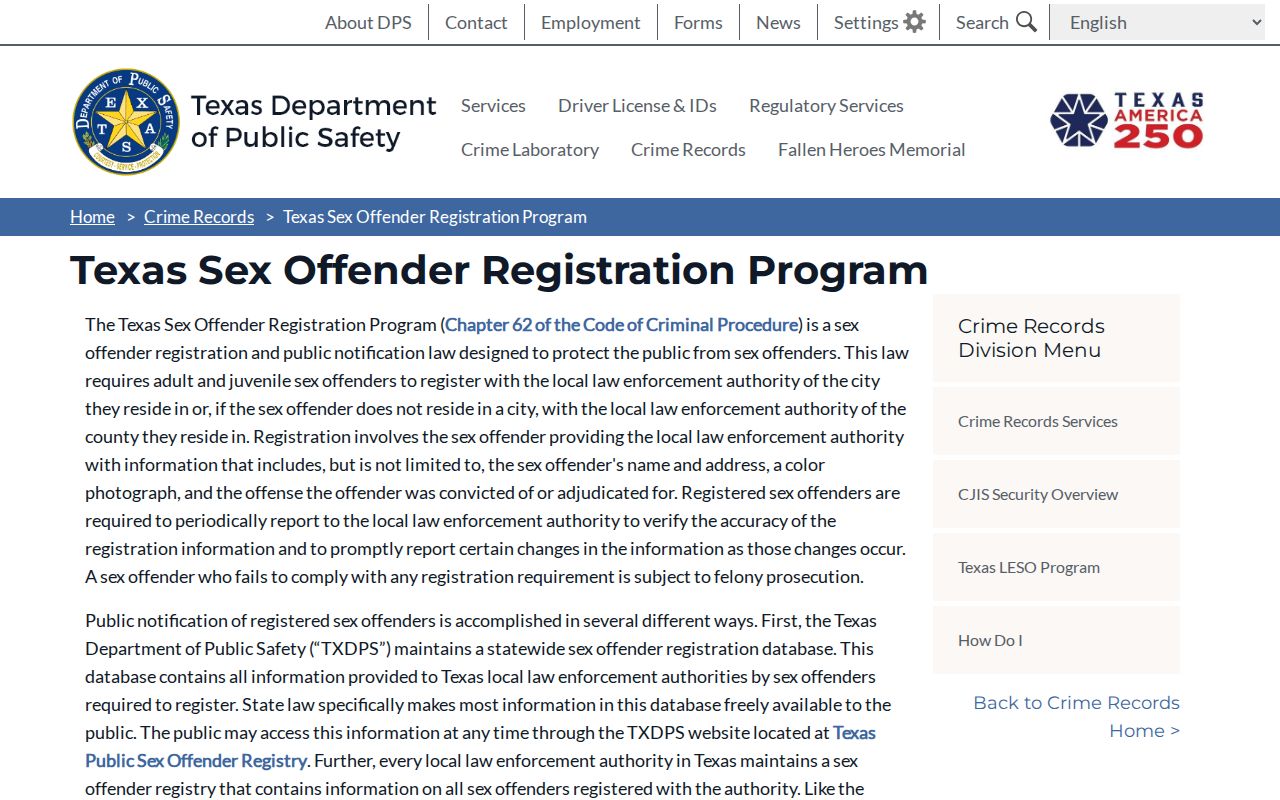
The DPS material helps keep the two concepts apart: risk guides the meaning of a profile, while Texas law sets the registration term and reporting duties.
Registration Levels and Duties in Texas
Adults generally register for ten years after the later statutory discharge, release, or dismissal point, or for life when Article 62.101 covers the offense or repeat circumstance. Juvenile cases use separate rules. A risk label alone cannot be used to infer that term. Verification also changes with the person's legal status and qualifying history.
| Level or status | Meaning | Duration relationship |
|---|---|---|
| 1 Low | Low danger; not likely to continue criminal sexual conduct | Does not itself set a ten-year or lifetime term |
| 2 Moderate | Moderate danger; might continue | Does not itself set the term |
| 3 High | Serious danger; likely to continue | Has heightened community-notification relevance |
| Civil Commitment | Separate sexually violent predator judicial status | Special reporting and notification rules apply |
Texas does not impose one general statewide school-or-park distance rule through Chapter 62. Supervision terms or local rules may still create limits in a specific case. A Colorado County map result therefore should not be read as a statewide distance-law judgment.
Colorado County Registry Verification Schedules
Annual verification around the registrant's birthday is the general pattern. A person with two or more sexually violent convictions or adjudications may face verification every 90 days. Civil commitment can require reporting every 30 days. These intervals concern the registrant's duty to report, not a promise that every public display changes on a set day. Contact the local authority for a current Colorado County compliance concern.
High-risk movement may also trigger notice beyond the searchable profile. DPS may mail bilingual English and Spanish postcards to the immediate community when a high-risk registrant or a civilly committed sexually violent predator moves in. Research found no Colorado County email or proximity-alert signup. The postcard process and local contact route are therefore more dependable than assuming an unverified alert feature exists.
Colorado County Cross-State Registry Search
The National Sex Offender Public Website, or NSOPW, adds a national search layer. It is most useful when someone has moved across Texas, when a destination lies near a state line, or when a name may appear in another jurisdiction's registry. NSOPW does not replace the Texas profile. It routes and aggregates participating public registry data, while Texas DPS remains the best source for Texas fields and local status.
The national portal screenshot assigned to Colorado County comes from that official Department of Justice source.
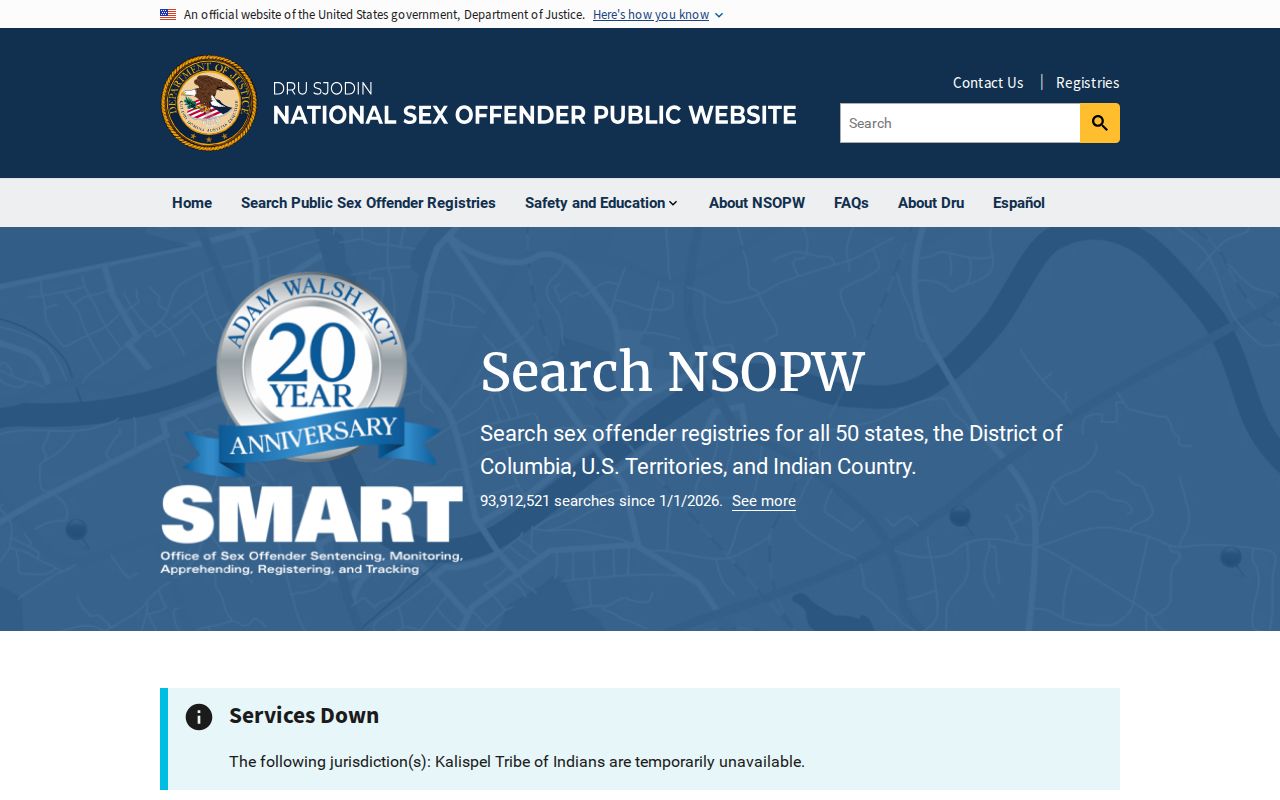
The national form is a practical second search, but any Texas match should be checked against the DPS profile and the correct Colorado County registering authority.
Using Registry Information Lawfully
Registry information supports personal, family, and neighborhood safety. It can help a household plan routes, understand a public notice, or check an address before a visit. It does not prove a new crime. A registration profile reflects a legal duty arising from an earlier conviction or adjudication, and its public fields have specific statutory purposes.
Texas Code of Criminal Procedure Chapter 62 governs registration and public notice. Article 62.005 makes most central registry information and the numeric risk level public while excluding protected fields. The same access does not grant permission to threaten a person, publish protected details, interfere with a household, or take vigilante action.
Use registry records lawfully: Misusing registry information to harass, threaten, or intimidate a registrant or household is a crime under Texas Code of Criminal Procedure Chapter 62.
When a Colorado County address seems wrong, save the public facts and contact city police or the sheriff. Do not visit the address to investigate. For a record error, the registrant must work through DPS and the reporting authority. For a safety emergency, call 911; for a routine compliance concern, use the local nonemergency channel.