
Criminal Court Cases in Colorado County
Colorado County criminal cases do not all reach the same counter. The 25th and 2nd 25th Judicial District Courts hear felony matters, and the District Clerk keeps those files at the Colorado County Courthouse. The constitutional County Court hears Class A and B misdemeanors, with its records held by the County Clerk at the Courthouse Annex. Colorado County has no statutory County Court at Law. That fact matters because a searcher should not look for a separate court-at-law database that does not exist here.
Four justice courts hear fine-only Class C complaints within their precincts. Columbus, Eagle Lake, and Weimar municipal courts also keep city ordinance and fine-only state-law cases. Appeals from justice and municipal courts may reach the County Court. A Colorado County court case search confined to the County Clerk can therefore miss a district felony, a JP complaint, or a municipal citation. Start with the charge level and the issuing court whenever those facts are known.
Colorado County Felony Court Records
For felony court records, the physical fallback is essential. The Colorado County District Clerk does not advertise a public felony web search. Its public terminals are at 400 Spring Street, Room 103, Columbus, Texas 78934. The counter is open Monday through Friday, 8 a.m. to noon and 1 to 5 p.m. Call 979-732-2536 or email districtclerk@co.colorado.tx.us before a trip when an older Colorado County criminal case may be archived.
The official District Clerk page shows the counter readers must use for full felony files.
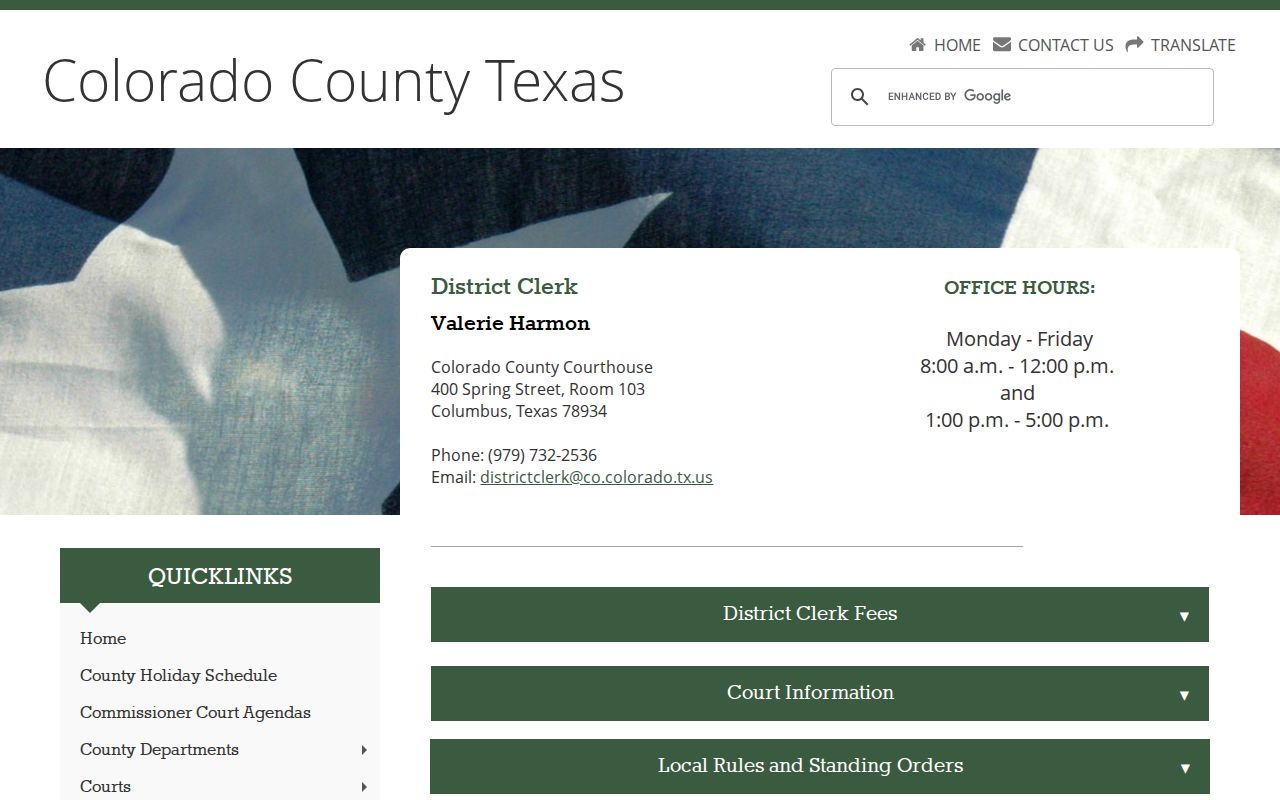
A terminal search can lead to the indictment, docket, hearings, judgment, and sentence. Copies cost $1 per page, and the clerk accepts credit or debit cards. The county has not published building-specific rules on parking, phones, or security items, so ask the clerk about access needs before travel.
Colorado County Case Record Searches
For County Court misdemeanors, begin with the Colorado County Clerk's criminal-record links. The clerk points to Tyler UCMS Smart Search and a separate Records Public Access system. County Clerk staff can provide case information by phone at 979-732-2155, but they do not perform broad name research for a caller. A focused case number, party name, filing span, or known charge helps route the request.
The County Clerk page is the official launch point for Colorado County misdemeanor court records.
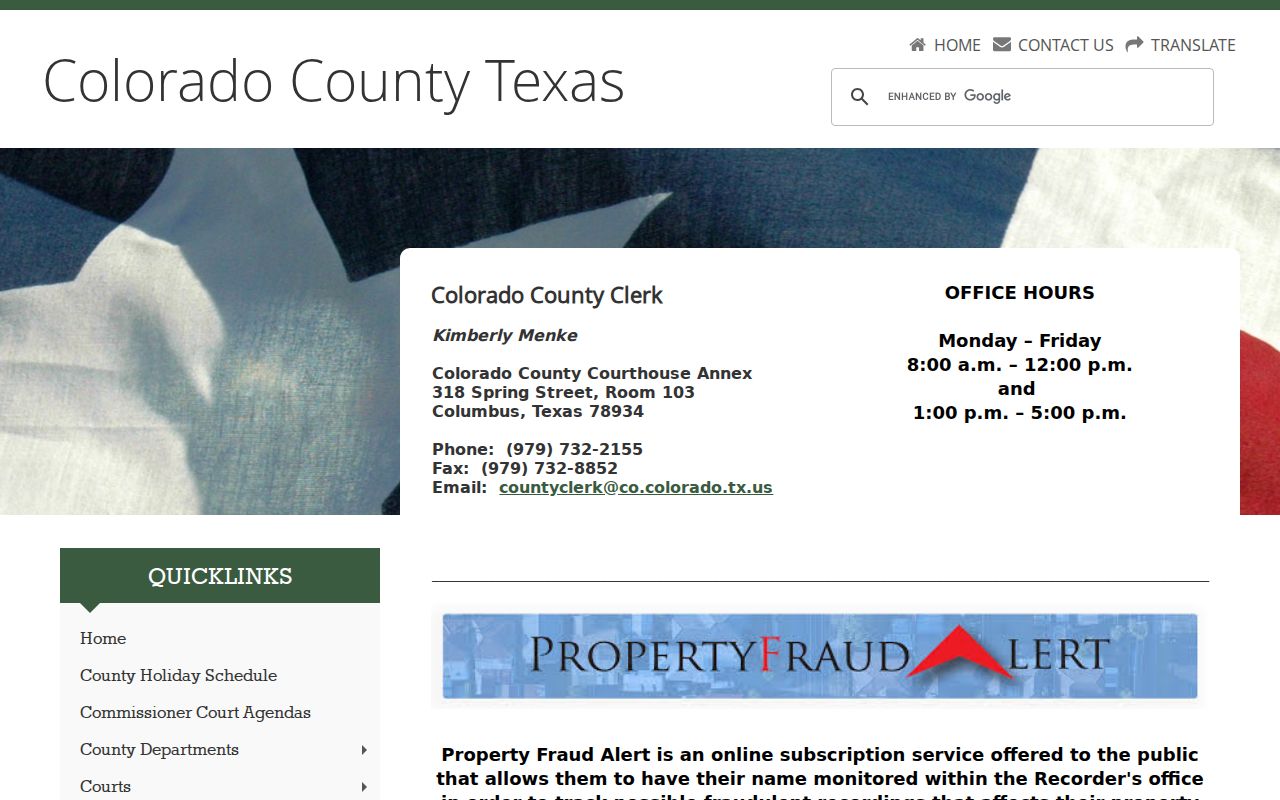
Use this sequence to keep the search tied to the right record holder.
- Identify whether the matter is a felony, Class A or B misdemeanor, or a fine-only municipal or justice case.
- Open UCMS for a County Court matter and search by record number or a full party name in Last, First format.
- Narrow the result with case type, status, filing dates, court location, or judicial officer when available.
- Read docket entries, hearings, judgments, and warrants as distinct parts of the Colorado County case record.
- Ask the correct clerk for the paper file or certified copies when the index lacks an image or final disposition.
Colorado County UCMS Court Search
The Tyler Odyssey UCMS portal searches publicly accessible records from participating counties. JavaScript and cookies are required. Colorado County users can go beyond a basic name query by separating cases, judgments, and warrants, then applying the appropriate filters. The portal may display a short inactivity warning, so collect name spellings, date ranges, and identifiers before starting.
The official portal capture reflects the search interface linked by the Colorado County Clerk.
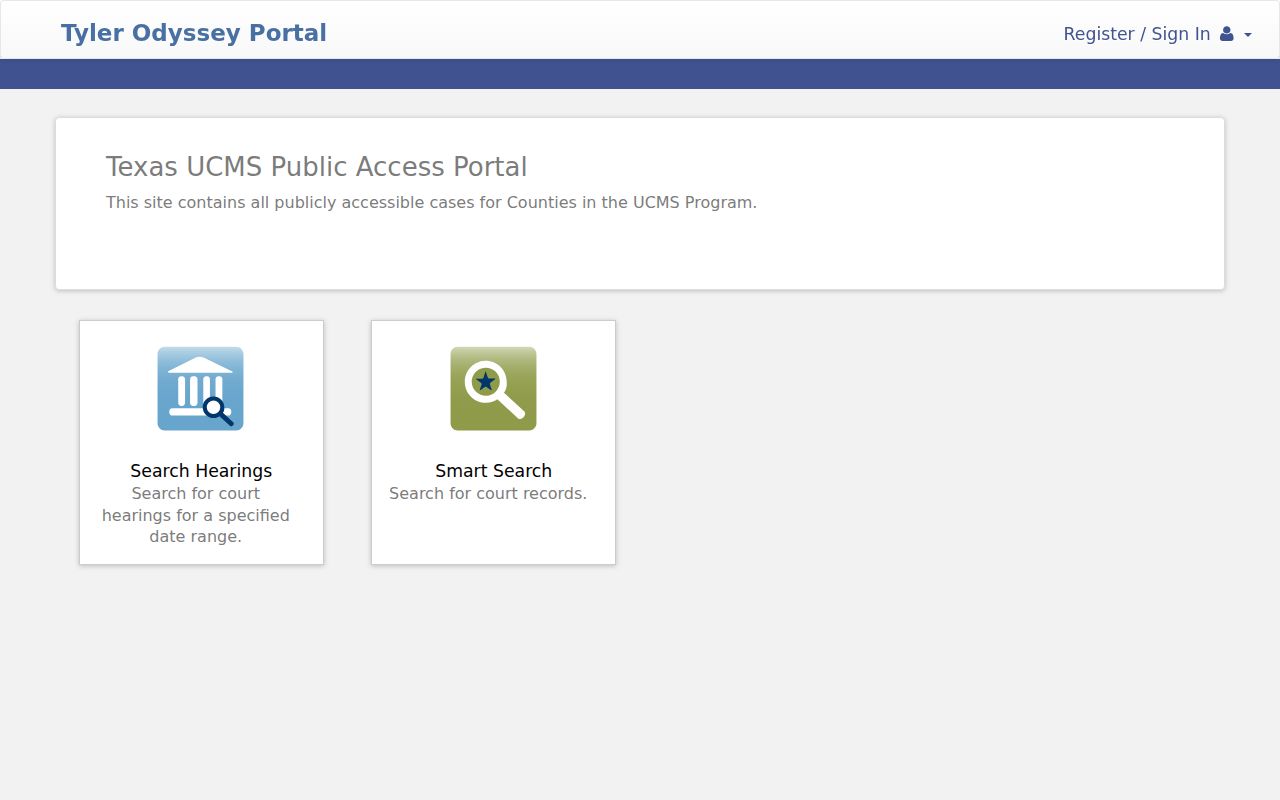
These are the inspected UCMS controls most useful for Colorado County court case lookup work.
| Field label | Type | Required | Use |
|---|---|---|---|
| Record Number or Name | Text | Basic alternative | Enter a case number or a name as Last, First Middle Suffix |
| Party Name | Text/select | First and last in structured mode | Add middle name, suffix, nickname, or Sounds Like when useful |
| Include | Checkboxes | No | Select Cases, Judgments, or Warrants |
| Identifiers | Text | No | Phone, FBI, sheriff's office, or booking number |
| Case filters | Select/date | No | Case type, status, filing dates, and judicial officer |
| Submit | Button | Yes to run | Sends the completed Colorado County query |
Note: UCMS omits sealed and nonpublic matters, so an empty result does not prove that no Colorado County case exists.
What a Criminal Case File Contains
A Colorado County criminal case file records prosecution, not just the arrest that came first. It may begin with a complaint, misdemeanor information, or felony indictment. Later entries can show counsel, motions, hearings, a plea, judgment, sentence, bond, and the financial ledger. Public access depends on the item. Victim and minor identities, sensitive identification numbers, sealed material, and some attachments can be withheld or redacted.
| Case identity | Case or record number, court, location, filing date, type, status, and assigned judicial officer. |
|---|---|
| Charging papers | Complaint, information, or indictment plus the filed statute and charge degree. |
| Parties and roles | Defendant, attorneys, and other public roles shown without protected victim data. |
| Docket and hearings | A dated list of filings, court settings, courtroom, and hearing events. |
| Plea and judgment | The plea, dismissal, acquittal, deferred adjudication, or judgment entered by the court. |
| Sentence and money | Custody or supervision terms, fines, court costs, and the case financial ledger. |
The clerk's filed disposition is the best source when an arrest-stage charge changed. A separate Colorado County arrest search can establish that booking occurred, but it cannot supply the court's final outcome.
Colorado County Cases in re:SearchTX
re:SearchTX is the statewide court-record aggregation layer. Access and participating records vary, so it should supplement the Colorado County clerk channels rather than replace them. Its strength is a wider search when a person may have cases in more than one Texas county. Its limits are just as important: a record may not participate, an attachment may not be available, and a local clerk may hold the only complete or certified file.
The statewide platform provides a second official view of Texas court records.
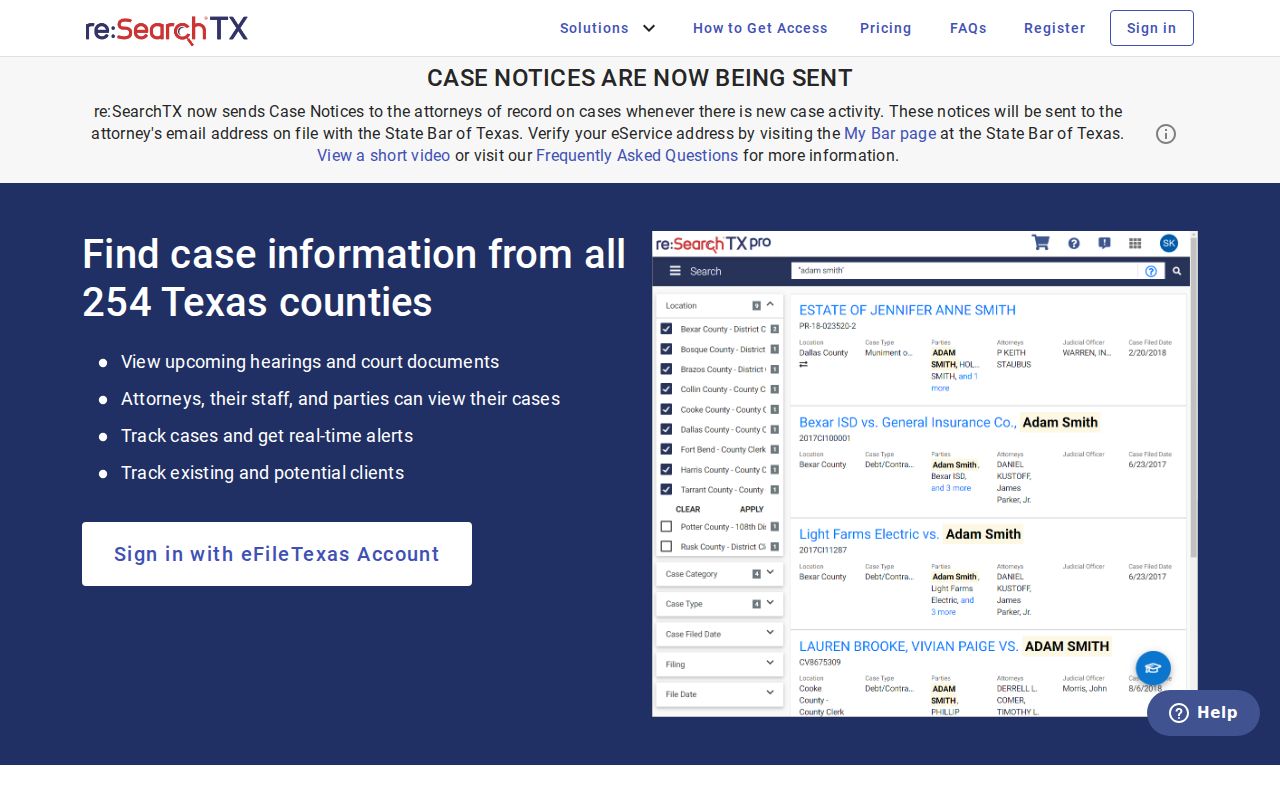
Compare any statewide result with the District Clerk for felonies or County Clerk for Class A and B misdemeanors. Municipal and justice matters may still require the issuing clerk. This layered search is useful because Colorado County has two district benches, one constitutional County Court, four justice precincts, and three municipal court systems.
Criminal Case Stages in Colorado County
A Colorado County criminal case generally starts with arrest and magistration, then moves through prosecutorial review. Texas law calls for an arrested person to be brought before a magistrate without needless delay and no later than 48 hours after arrest. A misdemeanor may proceed by information. A felony commonly moves through a grand jury, which may return an indictment or a no-bill. Arraignment states the filed accusation and receives a plea.
Case flow: Charges Filed › Arraignment › Pretrial › Plea or Trial › Disposition › Sentencing
Pretrial filings and hearings can change what is contested. A plea or trial leads toward judgment, while dismissal or acquittal ends without conviction. Sentencing follows a conviction, and an appeal can create a later record. The docket should be read in date order because an early charge label is not the last word.
Colorado County Case Outcomes Explained
Several court terms look alike but have different effects. A no-bill means the grand jury did not return a felony indictment. A dismissal ends a charge without conviction. An acquittal is a not-guilty result after adjudication. Deferred adjudication places a person on supervision while the court defers a conventional conviction; Texas DPS may still make deferred information public unless a valid order restricts it.
- Disposition
- The final or present outcome assigned to a charge or case.
- Docket
- The dated list of filings, hearings, rulings, and other court events.
- No-bill
- A grand jury decision not to return the proposed indictment.
- Information
- A prosecutor-signed charging paper commonly used for a misdemeanor.
- Deferred adjudication
- Supervision imposed while the court postpones a finding of conviction.
Do not infer expunction eligibility from a short status label. Texas Code of Criminal Procedure Chapter 55A has detailed, arrest-specific rules, and a dismissal alone does not guarantee that court and arrest records qualify.
Missing Colorado County Court Documents
The Colorado County Records Public Access system warns that its index is a guide or card catalog, not certified proof of authenticity. It also tells users to try spelling variations. Images can disappear while backups occur. If a docket appears but its document does not, keep the case number and ask the County Clerk whether the image is offline, restricted, or available only as a copy.
The county-linked archive is useful for locating records and making requests.
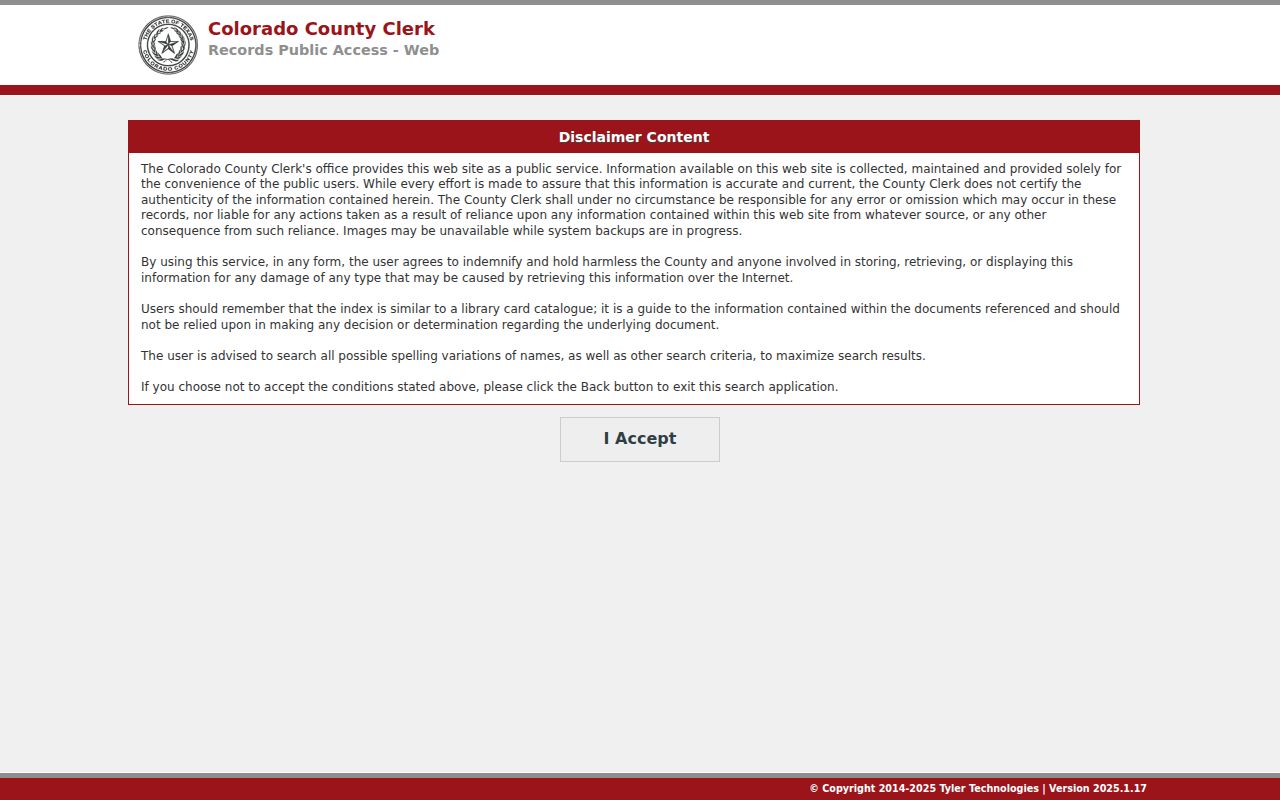
For a felony that never appears online, use the District Clerk terminal and ask about archived files. For a city or JP matter, call the issuing clerk. A missing web image is a delivery problem, not evidence that the Colorado County criminal case was erased.
Access Rules for Case Records
Texas court records are generally open, but access is not absolute. Juvenile files, expunged matters, nondisclosed information, protected victim details, private identifiers, and material sealed by a court can be restricted. Online views may show fewer fields than the paper file. Grand jury deliberations remain secret even when a returned indictment becomes part of a public Colorado County felony case.
The Texas Public Information Act applies to many government records, yet judicial records also follow court rules and the clerk channel. A public-information request is not a way around a sealing order. Ask the record-holding clerk why an item is unavailable and whether a redacted public copy, inspection, or certified copy can be supplied.